# Professional Vector Artwork Conversion vs Auto-Tracing: Which Delivers Better Results?
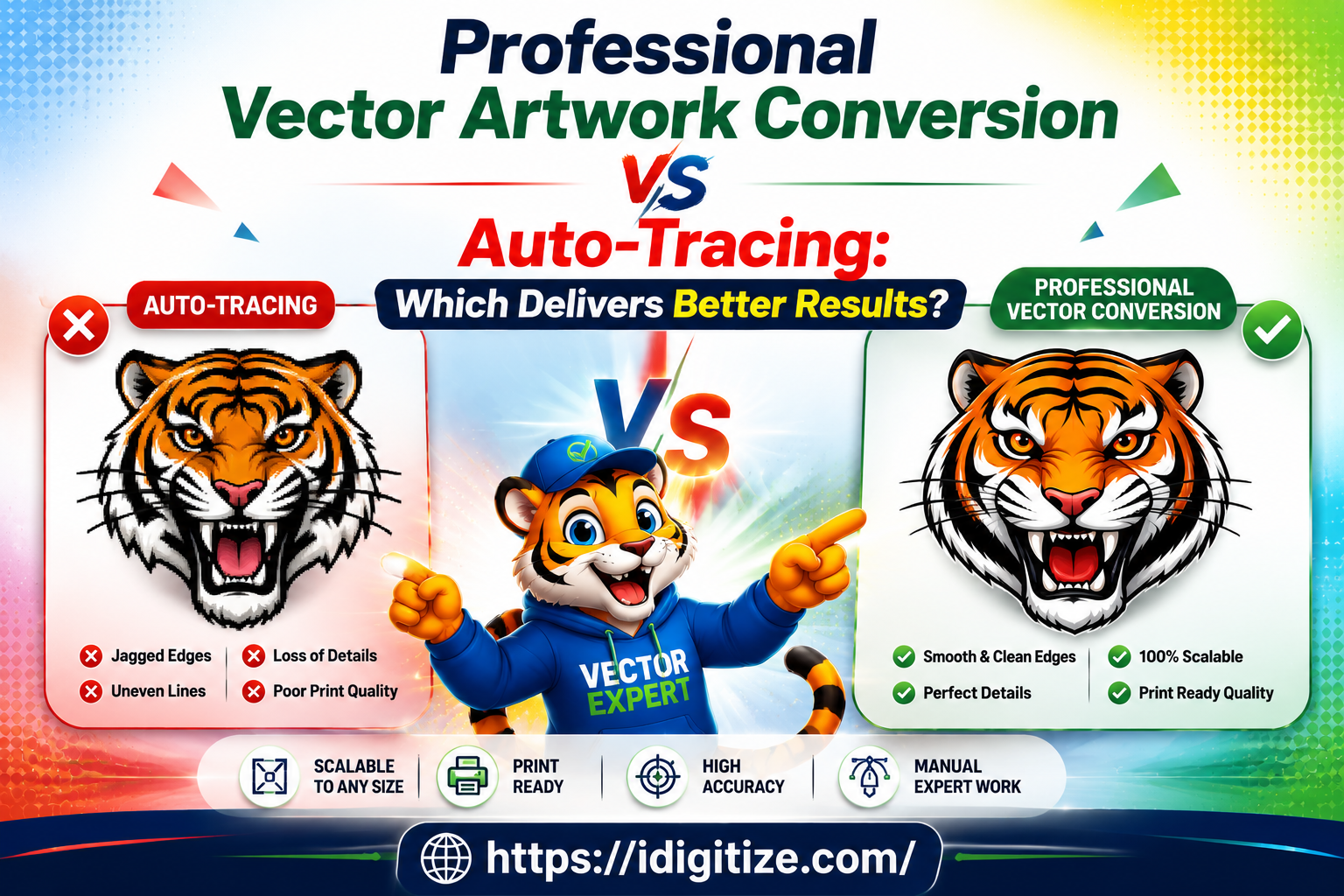
When it comes to creating clean, scalable, and print-ready artwork, [professional vector artwork conversion](https://idigitize.com/pages/vector-tracing) typically delivers better results than auto-tracing. While automated tools can provide quick conversions, they often struggle with accuracy, smooth curves, fine details, and brand consistency. Professional conversion offers greater precision, making it the preferred choice for businesses that need high-quality graphics for printing and marketing.
Choosing the right conversion method can affect everything from print quality to brand perception. Understanding the differences between professional vector conversion and auto-tracing helps businesses make informed decisions and avoid costly design issues later.
## Understanding Vector Artwork Conversion
Vector artwork conversion is the process of transforming a raster image, such as a JPG or PNG, into a scalable vector file. Unlike raster images, vector graphics are built using mathematical paths, allowing them to be resized without losing quality.
Common vector file formats include:
AI
EPS
SVG
Vector PDF
These formats are widely used in professional printing, embroidery, signage, and branding projects.
## What Is Auto-Tracing?
Auto-tracing is an automated process that uses software to detect shapes, colors, and outlines within an image and convert them into vector paths.
Many design programs offer built-in auto-tracing features because they can quickly create vector files from raster images.
### How Auto-Tracing Works
The software scans the image and attempts to identify:
Edges
Shapes
Color regions
Text outlines
It then generates vector paths based on what it detects.
While this process is fast, it often lacks the judgment and attention to detail that a professional designer provides.
## What Is Professional Vector Artwork Conversion?
Professional vector artwork conversion involves manually recreating artwork using vector design software.
Instead of relying solely on automation, an experienced designer carefully redraws:
Logos
Text elements
Curves
Shapes
Design details
This hands-on approach results in cleaner, more accurate artwork that closely matches the original design.
## Key Differences Between Professional Conversion and Auto-Tracing
### Accuracy of Artwork
#### Auto-Tracing
Auto-tracing software can misinterpret shapes, especially when working with:
Low-resolution images
Complex logos
Detailed illustrations
Faded graphics
This often results in distorted lines and inaccurate shapes.
#### Professional Conversion
A designer manually corrects imperfections and recreates elements precisely, ensuring the final artwork matches the original design as closely as possible.
Winner: Professional Conversion
### Quality of Curves and Lines
Smooth curves are critical for professional-looking graphics.
#### Auto-Tracing Challenges
Auto-traced files often contain:
Jagged curves
Uneven outlines
Excessive anchor points
These issues become noticeable when artwork is enlarged.
#### Professional Conversion Advantages
Experienced vector artists create smooth, controlled paths that produce cleaner graphics at any size.
Winner: Professional Conversion
### Text Accuracy
Text is one of the most common areas where auto-tracing struggles.
#### Auto-Tracing Problems
Software may:
Distort letters
Misread characters
Create uneven edges
Convert text into rough shapes
#### Professional Conversion Benefits
Designers can identify fonts, recreate text accurately, and ensure readability across all applications.
Winner: Professional Conversion
### Scalability and Print Performance
One of the main reasons businesses convert artwork to vector format is scalability.
#### Auto-Traced Files
Although technically scalable, poorly created vector paths can reveal flaws when enlarged.
For example:
Rough edges become more visible
Inconsistent shapes stand out
Design imperfections affect print quality
#### Professionally Converted Files
Manually optimized vector artwork maintains a polished appearance whether printed on:
Business cards
Promotional products
Vehicle wraps
Trade show displays
Billboards
Winner: Professional Conversion
### File Cleanliness and Editability
A clean vector file is easier to edit and manage.
#### Auto-Traced Artwork
Auto-tracing often generates thousands of unnecessary anchor points.
This can cause:
Larger file sizes
Slower editing
More difficult modifications
#### Professional Artwork
Manual vector recreation uses only the necessary points and paths, making future edits much easier.
Winner: Professional Conversion
## Speed and Cost Comparison
### Auto-Tracing
#### Advantages
Fast turnaround
Lower cost
Suitable for simple graphics
#### Limitations
Lower accuracy
Additional cleanup often required
### Professional Conversion
#### Advantages
Higher quality
Better print readiness
Greater accuracy
#### Limitations
Higher initial cost
Longer completion time
Winner: Depends on Project Requirements
For simple artwork, auto-tracing may be sufficient. For business branding and professional printing, manual conversion usually provides better long-term value.
## Side-by-Side Comparison
Feature Auto-Tracing Professional Vector Conversion
Speed Fast Moderate
Accuracy Moderate High
Print Quality Variable Excellent
Text Recreation Often Inaccurate Highly Accurate
Scalability Good but Imperfect Excellent
File Cleanliness Often Complex Clean and Organized
Editing Flexibility Limited Excellent
Brand Consistency Moderate High
## Real-World Examples
### Example 1: Company Logo for Signage
A local business submits a small website logo for a storefront sign.
#### Auto-Tracing Result
Uneven lettering
Rough curves
Visible imperfections
#### Professional Conversion Result
Sharp logo
Smooth lines
Professional appearance from any viewing distance
### Example 2: Screen Printing on Apparel
A clothing company needs artwork for hundreds of shirts.
#### Auto-Tracing Result
Small defects become visible during printing.
#### Professional Conversion Result
Clean artwork produces better print registration and sharper final products.
### Example 3: Vehicle Wrap Graphics
Large vehicle graphics require artwork that scales significantly.
Professional vector conversion ensures every design element remains crisp, even at large dimensions.
## When Auto-Tracing May Be Acceptable
There are situations where auto-tracing can work reasonably well.
### Suitable Projects Include
Simple black-and-white icons
Basic shapes
Temporary mockups
Internal design concepts
Even in these cases, reviewing and cleaning the artwork is recommended before final production.
## When Professional Vector Artwork Conversion Is the Better Choice
Professional conversion is usually the preferred option when:
Printing marketing materials
Creating brand assets
Producing signage
Preparing artwork for embroidery
Designing vehicle graphics
Printing promotional products
Maintaining brand consistency
For projects where quality matters, manual conversion often provides significantly better results.
## Pros and Cons
### Professional Vector Artwork Conversion
#### Pros
Superior accuracy
Cleaner artwork
Better print quality
Easier future editing
Consistent branding
Professional appearance
#### Cons
Higher upfront cost
Longer turnaround time
### Auto-Tracing
#### Pros
Fast processing
Lower cost
Convenient for simple graphics
#### Cons
Less accurate
Rough curves and edges
Potential printing issues
Poor handling of detailed artwork
## Common Mistakes to Avoid
### Choosing Speed Over Quality
Many businesses select auto-tracing because it is faster, only to discover quality problems during printing.
### Using Low-Resolution Source Files
Poor-quality originals make both auto-tracing and manual conversion more challenging.
### Ignoring File Review
Always inspect converted artwork before approving production.
### Assuming All Vector Files Are Equal
A file may technically be vector-based while still containing significant quality issues.
## Expert Tips for Better Results
### Start with the Best Source Image Available
Higher-quality originals make conversion more accurate and efficient.
### Request Print-Ready Formats
Ask for commonly used formats such as AI, EPS, SVG, and PDF.
### Consider Long-Term Use
A professionally converted logo can be used for years across multiple marketing channels.
### Think Beyond Today's Project
Investing in quality vector artwork now can save time and money on future branding and printing projects.
## Conclusion
While auto-tracing offers speed and convenience, professional vector artwork conversion consistently delivers better results in terms of accuracy, print quality, scalability, and brand consistency. Automated tools can work for simple graphics, but they often struggle with detailed logos and complex artwork.
For businesses that rely on professional branding, marketing materials, signage, apparel printing, or promotional products, manual vector conversion remains the most reliable solution. The higher quality and long-term usability often outweigh the additional time and cost involved.
## Author Note
This article is based on professional graphic design and print production practices. Results may vary depending on artwork complexity, source image quality, software capabilities, and printer requirements. Always review final artwork before production.
## Frequently Asked Questions (FAQs)
### 1. Is professional vector artwork conversion better than auto-tracing?
In most cases, yes. Professional conversion provides greater accuracy, cleaner paths, and better print-ready results than automated tracing.
### 2. Can auto-tracing create print-ready files?
It can for simple graphics, but complex logos and detailed artwork often require manual cleanup before professional printing.
### 3. Why do auto-traced logos sometimes look rough?
Auto-tracing software may create uneven curves, excessive anchor points, and distorted shapes, especially when working with low-resolution images.
### 4. Is professional vector conversion worth the extra cost?
For branding, signage, apparel printing, and marketing materials, the improved quality and long-term usability often justify the investment.
### 5. Which industries benefit most from professional vector artwork conversion?
Businesses involved in printing, embroidery, signage, promotional products, apparel decoration, and brand marketing typically benefit the most from professional vector artwork conversion.